
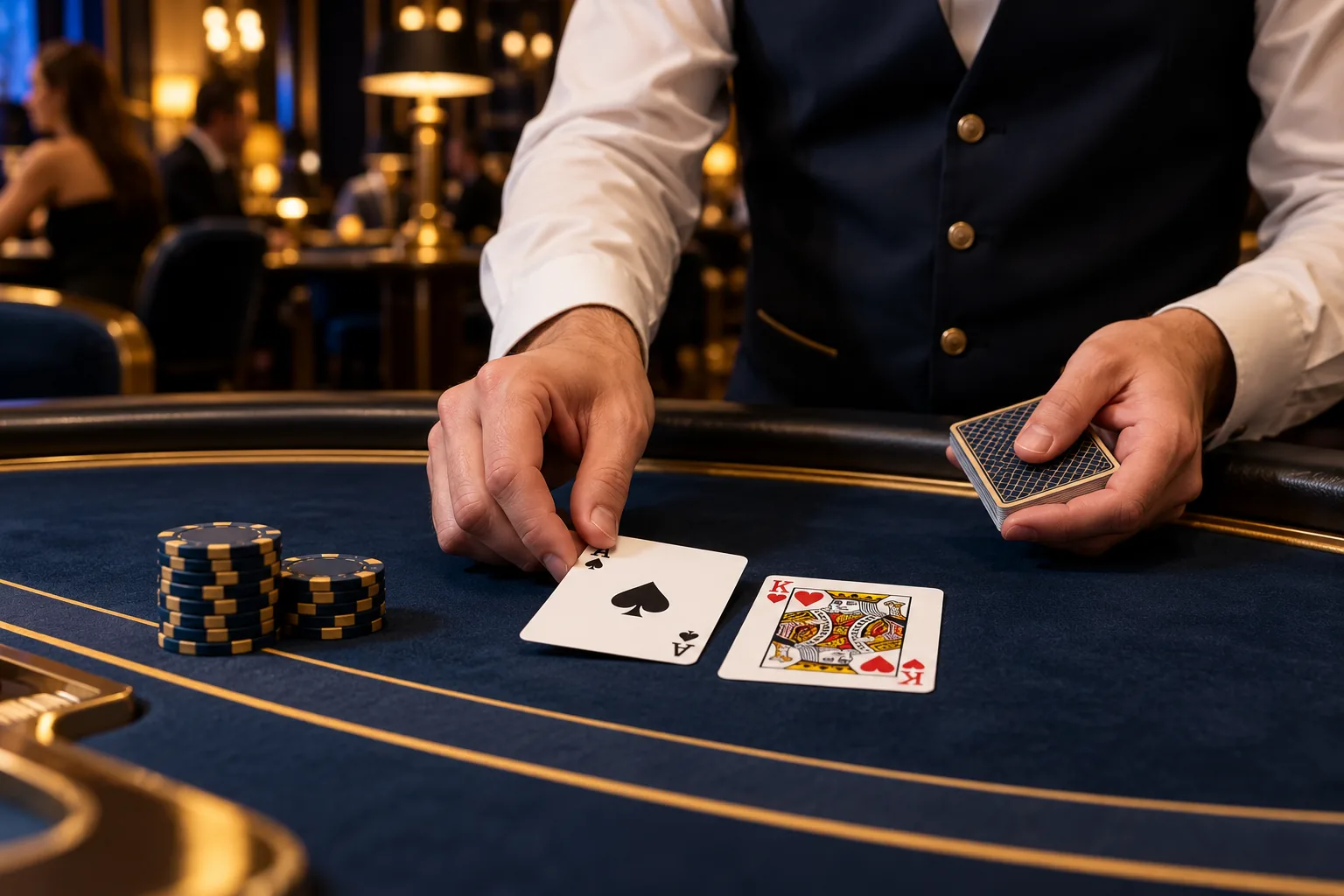
A card sliding across felt, a dealer turning a hand and a wheel slowing towards a pocket are small moments with very different meanings. They also show why live casino is more than one visual style. The Skol listing names live casino alongside slots and Indian card games; each format brings its own pace and focus.
In a live presentation, the table is part of the story. A shared view places the dealer’s movements, the cards or the wheel in the foreground. The presentation can make a sequence easy to follow, but the identity of the game still determines what those movements mean.
The changing shape of a blackjack hand
Blackjack centres on a hand total and its comparison with the dealer’s. In the conventional account described by Pagat, the aim is to get closer to 21 without going over. Number cards, picture cards and aces contribute in different ways, so a hand’s visible composition is as interesting as its displayed total.
An ace can be counted as one or eleven in that account. A hand containing an ace can therefore have a flexibility that another hand with the same total does not. The significance of a newly turned card depends on the cards already present. It is a compact narrative: an opening hand, a changing total and a final comparison.
At a live table the dealer’s actions make those stages visible. The camera can show a card as it is revealed and the arrangement of hands on the felt. House procedures and available choices vary by version, so the general form should not be mistaken for a particular table’s complete rules.
Roulette follows a moving wheel
Roulette presents a different kind of scene. Its visual centre is a wheel, with a ball moving around it until it settles in a numbered pocket. Cards do not accumulate and a hand total does not develop. The moment is a single result after motion, framed by the geometry and colour of the wheel.
A wheel’s layout matters to the version being described. For example, the New York State Gaming Commission’s rules distinguish single-zero and double-zero wheels. That example illustrates a variation in wheel layout; it is not a claim about a Skol table or Indian regulation.
On screen, a close view of the spinning wheel and a wider view of the table can tell complementary parts of the same story. One shows the movement; the other provides the setting in which the result is understood. Earlier results describe earlier spins and do not predict the next one.
What the live setting adds
A live dealer gives a presentation a human tempo. The pause before a card turns or while a wheel slows can make the sequence feel continuous rather than instantaneous. The table surface, lighting and camera angle affect how clearly the action is seen, while the named game supplies the meaning of what appears.
A live stream, an animation and a prerecorded sequence are different kinds of presentation. A picture alone cannot establish which one a particular service uses. The distinction matters because the word “live” describes a way of showing an event, not a universal set of game rules.
That perspective also helps connect live tables with familiar Indian card formats. Teen Patti has a compact three-card hand, while Andar Bahar revolves around a matching rank. A dealer can present either kind of activity, but the two formats retain their separate structures. Watching the movement of cards is only one part of understanding the scene.
Slots create another rhythm
Slots, also named in the Skol source listing, organise attention around a different visual language: reels or symbol arrangements rather than a dealer’s hand. Familiar images such as fruit, bells and numerals can make a reel easy to recognise, while other designs use characters, colours or a themed setting.
A slot’s symbols belong to the rules of the particular game. A familiar icon can appear in several designs without carrying the same meaning in all of them. The game’s paytable describes its own combinations and features; a picture of a reel is not a promise about what a spin will return.
Where a live table builds anticipation through a visible physical sequence, a slot can compress its action into the movement and final arrangement of symbols. Both can be presented on a screen, yet they communicate through different details. One invites attention to the dealer or wheel; the other to the composition of a game’s symbols.
Different formats, one editorial view
Skol-in.com is an independent information publication for readers in India. The catalogue on this site identifies artwork from its named source catalogues; it does not establish that those games are available through Skol. Account panels are previews, and this publication does not process payments or operate real-money games.
Blackjack, roulette and slots make useful contrasts because each tells a round differently. A hand develops, a wheel settles and a set of symbols appears. None of those narratives guarantees a result. Gambling involves a risk of loss, and readers should consider the actual rules and conditions of any named version.